
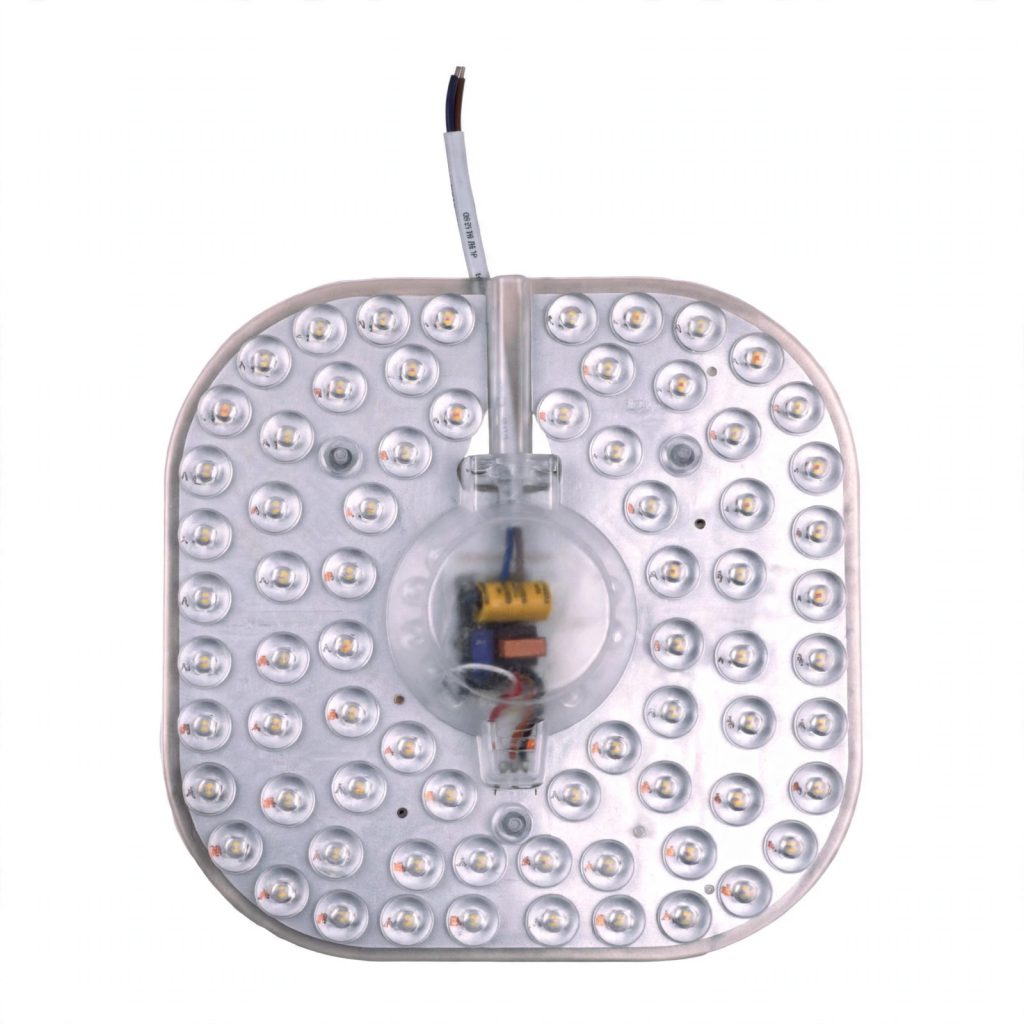
Open up a modern ceiling light and you will usually not find a bulb. Instead you will find a flat board covered with small LED chips, wired to a driver and fixed to the fitting. That board is an LED module — the light engine of the lamp — and its shape decides a lot about how the finished ceiling light looks, lights a room and gets repaired.
At MUYI we make LED modules in three main shapes: square, round and ring. This guide explains what each shape is for, where it works best, and what to check before ordering.
What is an LED module?
An LED module is a ready-made light source: LED chips mounted on a board, usually with the wiring and connection points built in. A ceiling light maker — or a repair technician — fits the module into a housing, connects the driver, and has a working lamp.
Modules differ from bulbs in one important way: they are designed to live inside a fitting rather than screw into a socket. That makes them the natural choice for ceiling lights, panel lights and other fixed luminaires, where the fitting itself is part of the design. It also makes repair simpler: when a ceiling light fails, the module can often be swapped without replacing the whole fitting.
Square modules: the workhorse
Square modules are the most versatile shape. Their straight edges pack neatly into rectangular and square ceiling fittings, and they distribute their LED chips evenly across a flat area, giving broad, uniform light with few dark spots.
That even spread makes square modules a good fit for general room lighting — the main ceiling light in a living room, an office or a shop. They also suit panel-style fittings, where the module sits behind a diffuser and the whole panel glows evenly. If you are choosing one module shape to cover the widest range of ceiling lights, square is usually the safe starting point.
Round modules: for round fittings
Round modules are made for round ceiling lights, and the logic is simple: a round board fills a round fitting without wasted space or awkward gaps. The LED chips sit in a circular pattern, so the light spreads evenly in all directions from the centre of the fitting.
Round modules are common in bedrooms, corridors and hospitality spaces, where round ceiling lights are the standard look. They are also a popular choice for downlight-style ceiling fittings, where a compact round module keeps the fitting slim. When your fitting is round, a round module is usually the cleanest fit — and the easiest to explain to an installer.
Ring modules: light with a design statement
Ring modules — sometimes called donut or annular modules — arrange their LED chips in a circle with an open centre. That open centre is the point: it lets designers build ceiling lights with a distinctive look, such as a glowing ring, a central decorative element, or an opening for a second light source.
Ring modules suit decorative ceiling lights, where appearance matters as much as illumination: hotels, restaurants, showrooms and modern homes. The ring shape spreads light in a wide, even circle, so a ring module can light a room while doubling as the room’s visual centrepiece.
Choosing between the shapes
The shape decision usually answers itself once you know the fitting:
- Match the fitting. A square fitting takes a square module, a round fitting takes a round module. Forcing the wrong shape into a fitting wastes space and complicates assembly.
- Think about the light pattern. Square and round modules give even, general light. Ring modules give a wide spread with a decorative centre — better where the light itself is part of the look.
- Plan for repair. One advantage of modules is serviceability: a failed module can be replaced while the fitting stays on the ceiling. Stocking the same module shapes your customers already use makes after-sales support much simpler.
- Check the driver. Every module needs a compatible driver. Before ordering, confirm the driver type and connection with your supplier, and make sure your assembly team knows the wiring — a module and driver that do not match are a failed fitting, not a product.
Modules, finished lights and your business
Modules are not only for ceiling light makers. They are also a practical product line for distributors who serve the repair and replacement market, and for local assemblers who build their own ceiling lights. Like the rest of our range, MUYI LED modules are available as finished products, in SKD or CKD form, and with OEM branding, so you can assemble under your own brand and packaging. Our module range sits alongside bulbs, UFO lights, panel lights, downlights and ceiling lights from 3W to 200W — you can browse the full catalog on our products page (https://muyibulbs.com/products/) and read about local assembly on our SKD & CKD page (https://muyibulbs.com/skd-ckd/).
If you build or sell ceiling lights, modules are worth a closer look: one module shape, stocked well, can support a whole line of fittings. Our minimum order is 1,000 pieces per product, and we reply to inquiries within 24 hours on business days. Tell us the fittings you make and the shapes you need — send your inquiry here: https://muyibulbs.com/contact/ — and we will help you choose the right module for each one.