
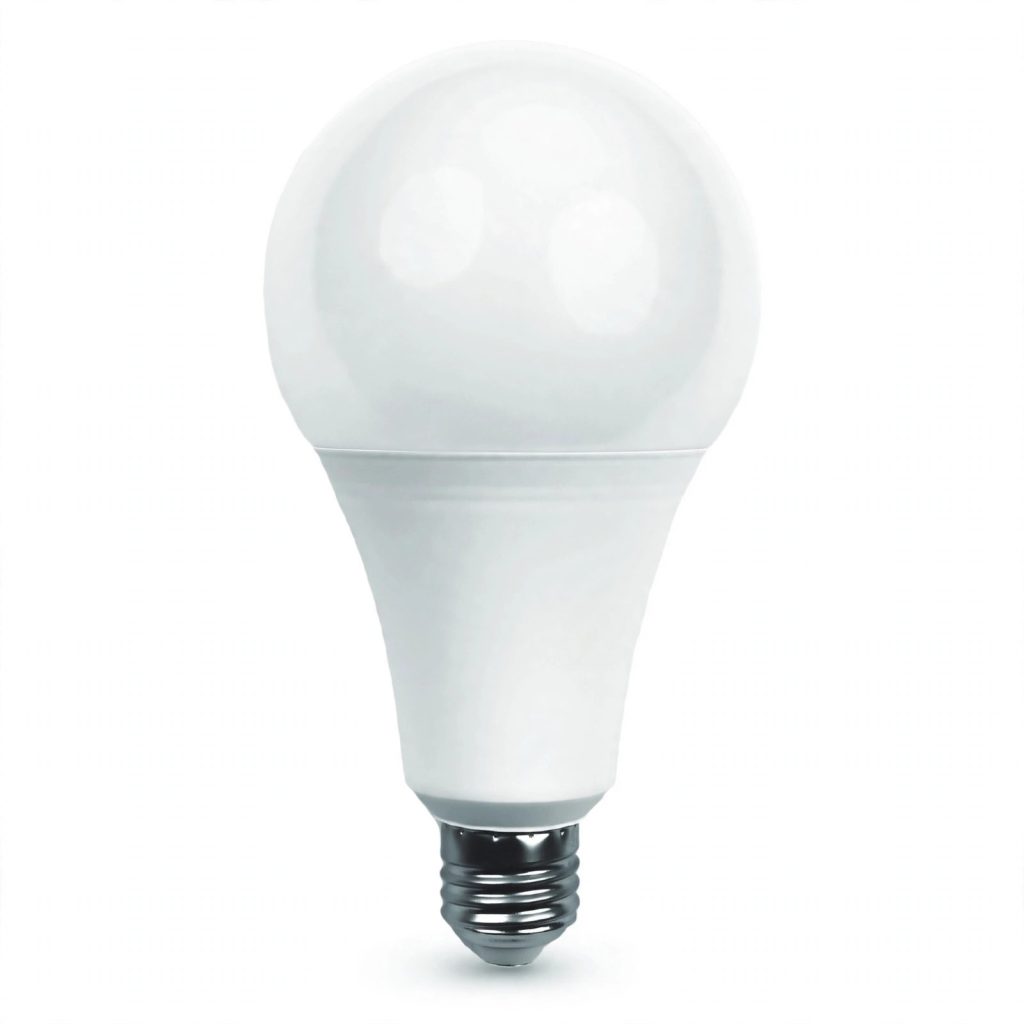
Ask a customer what bulb they want and they will say “a 9-watt” or “a 60-watt” — even when what they actually mean is “bright enough for my kitchen.” Watts are the language buyers inherited from incandescent bulbs, but watts no longer describe brightness. For importers and distributors, stocking by wattage alone — without understanding lumens — is how a range ends up with slow sizes nobody needs and gaps exactly where demand is.
This guide explains watts and lumens in plain terms, gives typical brightness expectations by room and use, and ends with a simple stocking recommendation you can adapt to your market.
Watts vs lumens: the one distinction that matters
Watts measure power consumed. Lumens measure light produced. That is the whole distinction, and everything else follows from it.
With old incandescent bulbs the two moved together — more watts always meant more light — so “wattage” became shorthand for brightness. LED broke that link. A well-made LED produces far more light per watt than an incandescent, and two LED bulbs with the same wattage can produce noticeably different amounts of light depending on the chips and driver inside.
The familiar equivalents below are the ones your customers still carry in their heads. They are general market guidance, not the specification of any single product:
- A 40W incandescent gives roughly 450 lumens — a typical LED replacement is around 5W
- A 60W incandescent gives roughly 800 lumens — a typical LED replacement is around 9W
- A 75W incandescent gives roughly 1,100 lumens — a typical LED replacement is around 12W
- A 100W incandescent gives roughly 1,600 lumens — a typical LED replacement is around 15W
When you compare factory offers, compare lumens per product — and ask for the figure in writing. A cheaper bulb at the same wattage may simply be a dimmer bulb.
How many lumens per room or use?
Brightness needs depend on the size of the space and what happens in it. As typical guidance for the total light in a space:
- Bedrooms and living rooms: a comfortable general level is roughly 100–200 lumens per square metre — for a 15 m² room, think in the region of 1,500–3,000 lumens total, often split across two or three bulbs.
- Kitchens, bathrooms and work areas: tasks need more light — roughly 300–500 lumens per square metre over counters, desks and worktops.
- Shops, offices and showrooms: brightness sells and supports work; plan toward the upper end, and spread it across panels and downlights rather than a few very bright points.
- Warehouses, workshops and high ceilings: individual bulbs stop being the right tool. This is where high-output fittings such as UFO high-bay lights earn their place, mounted high and spaced across the ceiling.
Two practical notes. First, these are totals for the room, not per bulb — three moderate bulbs usually light a room better than one very bright one. Second, rooms with dark walls, high ceilings or dusty environments need more light than the same room in ideal conditions, which is common across many of the markets MUYI supplies.
Which wattages sell fastest?
Every market has its own pattern, and your own sales data beats any guide — but across residential markets in Africa, India, the Middle East and Southeast Asia, the pattern is broadly consistent:
Residential core (fast-moving, year-round): the middle of the LED bulb range — roughly the 5W to 15W band in typical LED terms, covering the 450–1,600 lumen equivalents above. The 800-lumen class (the old “60W replacement”) is usually the single fastest seller, because it fits the most rooms in the most homes. Smaller bulbs serve lamps and low-light fittings; the top of the band serves large living rooms and small shops.
Emergency bulbs deserve a separate mention in markets with unreliable power: they stock like a residential product but solve an outage problem, and in many African and South Asian markets they move in serious volume alongside standard bulbs.
Commercial and project range (slower per SKU, larger per order): higher-wattage bulbs for halls and large spaces, plus the fittings — panel lights and downlights for offices, shops and hotels, UFO high-bay lights for warehouses and factories, ceiling lights for residential projects. Project buyers order fewer lines in bigger quantities, and they ask about lumens first, because their specifications are written in lumens.
Base and voltage: the market differences that change the order
Lumens decide how bright; two other details decide whether the bulb works at all in your market.
Base type. B22 bayonet is the everyday standard in India and several other markets shaped by British practice, while E27 screw dominates across much of the Middle East and Southeast Asia and appears widely in Africa. Our guide to E27 vs B22 LED bulbs covers how to set the split for your market — and why guessing it is expensive.
Voltage habits. Most of MUYI’s export markets run on 220–240V, but the stability of that supply varies a great deal. Where voltage swings are common, ask any factory about the voltage range a bulb is built for before you order, and weight it in your comparison — a bulb that fails early in a surge-prone area damages your brand, not the factory’s. Where outages are a daily fact, pairing standard bulbs with emergency bulbs in the same range covers both needs.
A simple stocking recommendation
If you are building or refreshing a range, start with two tiers:
Core range — stock deep:
- LED bulbs across the residential band, in both the base types your market uses, weighted toward the 800-lumen class
- A mid-band option above it for large rooms and small commercial spaces
- Emergency bulbs, if your market has regular outages
Project range — stock ready:
- Panel lights and downlights for offices, retail and hospitality
- UFO high-bay lights for warehouses, workshops and factories
- Higher-output bulbs and ceiling lights for halls and residential projects
Then adjust by what your market tells you. If one wattage class outsells the rest three to one, deepen it and trim the tail. MUYI’s range runs from 3W to 200W across bulbs, panels, downlights, high-bays, ceiling lights and modules, so the core and project tiers can come from one supplier — browse the full range on our products page to map it against the tiers above.
Ordering the right wattage mix from MUYI
However you split the range, each wattage and base variant counts as its own product: MUYI’s minimum order is 1,000 pieces per product, with a 7-day lead time, in finished, SKD or CKD format. If you assemble locally, the SKD vs CKD guide explains how the two formats differ; if you want the range under your own brand, our OEM guide walks through what to send a factory first. New to factory ordering altogether? Start with how to order LED bulbs from a factory in China.
Tell us your market, the wattages and bases you want to stock, and your quantities on our contact page — or message us on WhatsApp at +86 188 7397 4440 — and we will quote the mix that fits.